Florida's Best PoolsTraining Academy
Pillar guide · 8 articles

Pool Water Chemistry: The Complete Guide

Water chemistry is the 80/20 of pool care. Get the numbers right and algae, cloudy water, irritated skin, and corroded equipment mostly solve themselves. Get them wrong and nothing else you do matters.

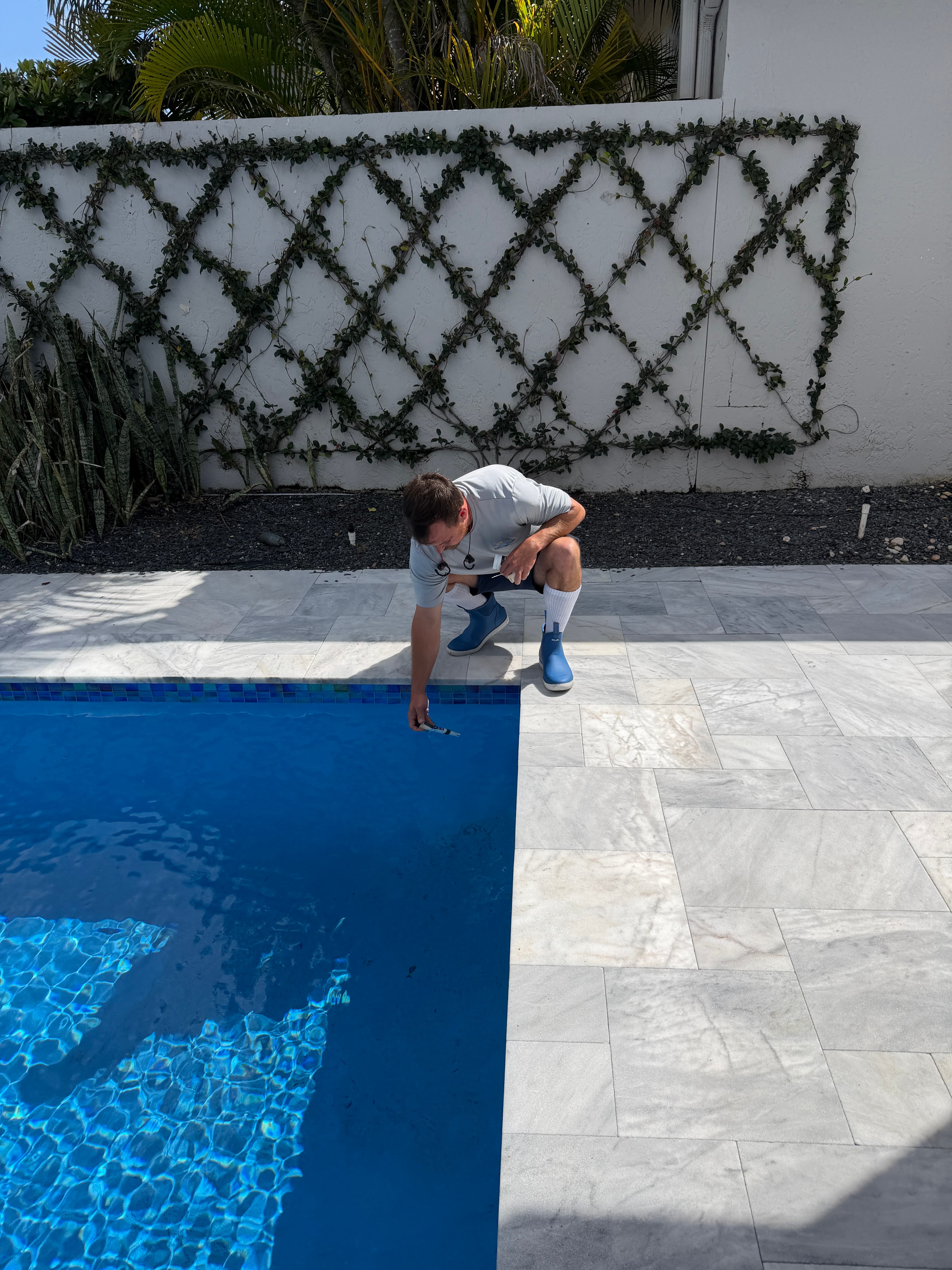
Pool Water Chemistry — ambient photo

Water chemistry is the 80/20 of pool ownership. Every problem a Florida pool owner will ever face — cloudy water, algae blooms, itchy skin, equipment corrosion, plaster etching, scale, even bad smells — traces back to a number that got out of range and stayed there.

The good news: there are only six numbers that really matter, and each one has a tight target range. Keep them in range and nearly every other problem becomes preventable. This pillar is your map to those numbers: what they are, why they matter, how to test them, and exactly what to do when they're off.

The six numbers that run your pool

Before you buy a single chemical, memorize these ranges. Every guide in this pillar drills into one of them.

ParameterIdeal rangeWhat it does
pH7.4 – 7.6Controls chlorine effectiveness and swimmer comfort
Free chlorine1 – 3 ppmActually sanitizes the water
Total alkalinity80 – 120 ppmKeeps pH from swinging
Cyanuric acid (CYA)30 – 50 ppmProtects chlorine from UV
Calcium hardness200 – 400 ppmPrevents etching and scale
TemperatureN/AAffects chemistry reactions and comfort

How water chemistry actually works

Think of your pool as a slow-moving reactor. Sunlight burns off chlorine. Bather load adds contaminants. Rain dilutes your chemicals and drops pH. Evaporation concentrates everything that's left. Your job as an operator is to dose the inputs to keep each parameter inside its target range, so the sanitizer can do its job and the water stays balanced against the pool surface.

The biggest mistake new pool owners make?Treating symptoms. They see algae and add chlorine. They see cloudy water and dump clarifier. They see green and panic-shock. But algae and cloudiness are almost always downstream of a chemistry number that's out of range — usually CYA too high or pH drifted up. Fix the root and the symptom evaporates.

Testing: the non-negotiable habit

You cannot manage what you do not measure. In Florida's climate, we recommend testing at least twice per week during summer and once per week in cooler months. Use a liquid reagent kit (Taylor K-2006 is our pick) or a high-quality test strip. Record the numbers — paper, phone, anywhere — because trends matter more than single readings.

Dive deeper: guides in this pillar

Each guide below takes one number and walks through it in plain English:

All guides in this pillar

7 min read
How to Balance Pool pH

What the ideal pH range is, how to test it, and exactly how much acid or base to add to hit 7.4–7.6.

Read guide →
8 min read
Chlorine Levels for Pools

Free vs. total vs. combined chlorine, why it matters, and how to keep residual between 1–3 ppm.

Read guide →
6 min read
Total Alkalinity: The pH Shock Absorber

Total alkalinity (TA) keeps pH from bouncing. Here's how to test, raise, and lower it safely.

Read guide →
7 min read
Cyanuric Acid (CYA / Stabilizer)

CYA protects chlorine from UV — but too much neuters your sanitizer. Target 30–50 ppm and know when to drain.

Read guide →
5 min read
Calcium Hardness

Too low and water eats plaster; too high and you get scale. Aim for 200–400 ppm (plaster) or 150–250 ppm (vinyl).

Read guide →
6 min read
Shocking a Pool

When, why, and how to shock. Breakpoint math, night vs. day, and why half-shocking makes things worse.

Read guide →
8 min read
Langelier Saturation Index (LSI)

LSI combines pH, temperature, hardness, alkalinity, and TDS into a single balance score. Keep it between -0.3 and +0.3.

Read guide →
5 min read
Phosphate Removal

Phosphates don't hurt swimmers, but they feed algae. When removal makes sense — and when it's a waste of money.

Read guide →
Related pillars

Keep exploring

Pool Cleaning & Maintenance

Skim, brush, vacuum, and service your filter. A disciplined weekly routine prevents 90% of pool problems.

Troubleshooting Pool Problems

Cloudy water, algae, stains, foaming — every problem has a cause. Here's how pros diagnose and fix them.

Pool Equipment

Understand what every piece of your equipment pad does — and how to get more years out of it.

Pool Safety

Florida pool safety standards, VGB drain covers, fencing code, and the emergency response every operator should know.

Florida Pool Care

Hurricane prep, year-round operation, hard water, screen enclosures, and the challenges unique to Florida.

Spa & Hot Tub Care

Spas are not small pools. Higher temps, smaller volume, higher bather load — different rules.

For Pool Technicians

CPO certification, tools of the trade, route building, and Florida licensing for pool techs.

Pool Math & Calculations

Pool volume, chemical dosage, and breakpoint math. The numbers behind every safe, correctly-dosed pool.

Disinfection Theory & Chemistry

The HOCl vs. OCl equilibrium, CT values, and disinfection by-products. The science every CPO-level operator needs to know.

Recreational Water Illness (RWI) Prevention

Cryptosporidium, fecal incident response, and the RWIs that close pools. The CDC-compliant playbook.

Pool Hydraulics & Circulation

Turnover rate, total dynamic head, cavitation, suction entrapment, and the physics of making water move through a pool.

Filtration Engineering

Filter media rate, micron ratings, sand vs. cartridge vs. DE, and what filters can and can't actually remove.

Commercial Pool Operations

Chemical feeders, ORP/pH controllers, pool heating, indoor air quality, and the electrical safety every commercial operator needs.

Compliance, Codes & Standards

The MAHC, ANSI/APSP/ICC standards, ADA accessibility, and the federal alphabet soup of pool regulation.

Florida Pool Licensing & Regulations

Every Florida pool license explained in plain English — what each one lets you do, how to get it step-by-step, and which counties make it harder.

Pool Plaster Startup & New Builds

New plaster has a 30-day chemistry window. Do it right and the surface lasts 15–20 years. Do it wrong and you're looking at etching, scaling, and a warranty void.

Records & Risk Management

Required daily logs, incident reporting, operator duty of care, and the documentation that defends you in court.

Ready for a pool that takes care of itself?

Get a quote from our team. No pushy sales calls — just a clear price and a start date.

Request a Service QuoteSee Services